


Programmes and workshops built on twelve years in classrooms and a doctorate in writing the self.
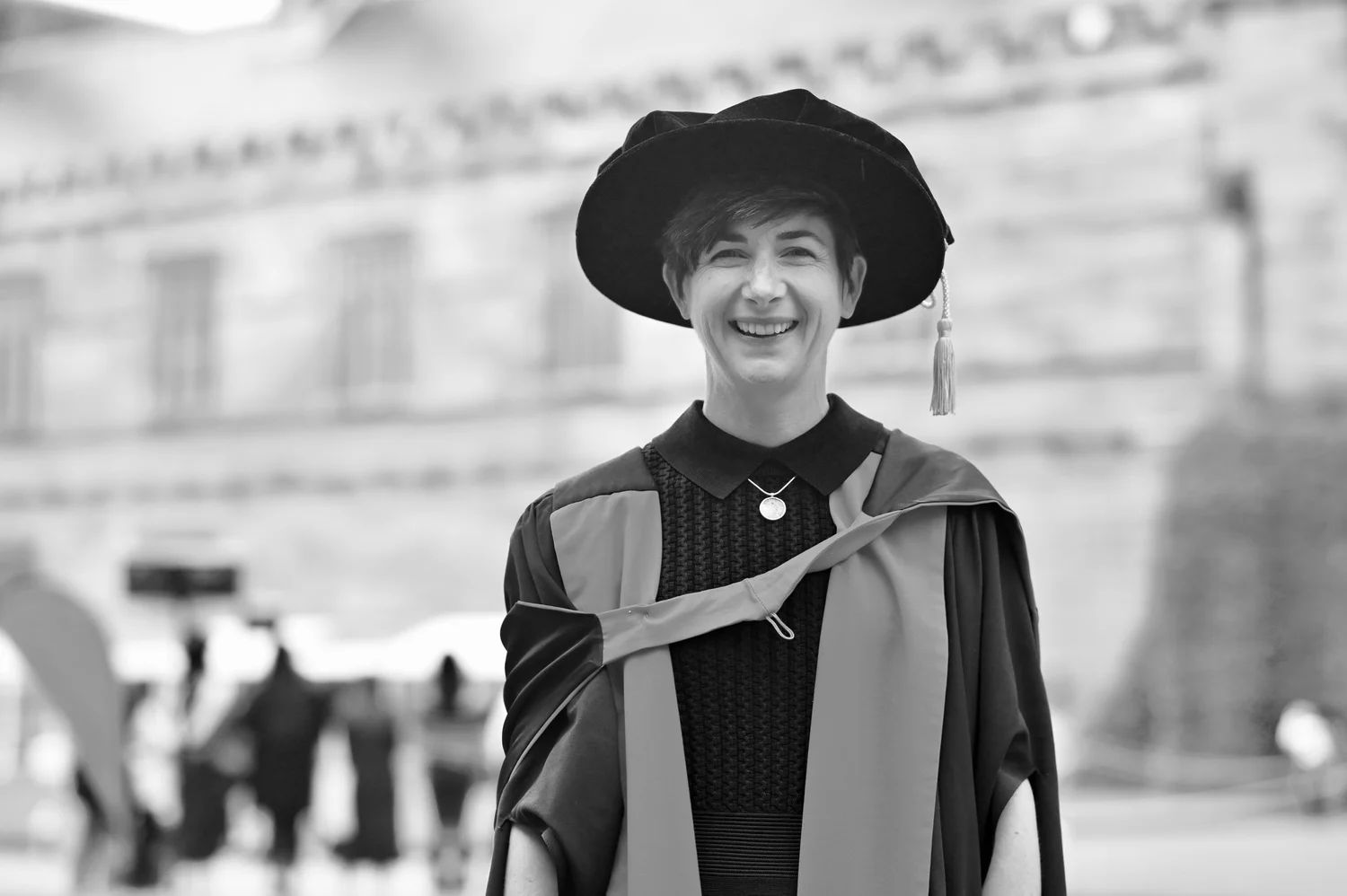
Before I wrote books for a living I spent twelve years teaching in secondary schools, as a dean and as an across-schools lead in a Kāhui Ako, and then ran a youth trust as its first general manager. My doctorate at the University of Sydney studied what happens when a person writes their own life as a character, under another name and over several drafts. I now design programmes for schools, trusts and companies, and run writing workshops for founders, chief executives and leadership teams built on the method I tested in my doctoral research.
Writing for leaders.
A chief executive tells the company’s story to a board, investors and staff every week, and the version told in public is rarely the one they would write for themselves. My research found that a writer who turns themselves into a character, with permission to invent, can see what happened and what it meant more clearly than first-person recall allows. When I rewrote a section of my own material in the third person, I recorded that “immediately, the words came alive”, and I could review the work with far less emotional charge.
The workshops use short timed writing, by hand, read aloud to a partner or a small circle who say back what they heard and ask one question. The exercises draw on Tim O’Brien’s distinction between happening truth and story truth, on writing in the third person under an alter-ego name, on writing in the conditional (what might have been said, what would have happened) to reach a conversation that has not been had, and on stripping a sector’s jargon out of a founding story to see what it was covering.
Formats.
- A writing strand inside a leadership retreat or conference, from 50 minutes a day, built around whatever else the group is doing that week.
- An adventure retreat over several days, with short writing at first light and at stops on the track, and a longer session each evening.
- Work inside a company, where the writing collects the stories staff tell about the place, produces written debriefs after major moments, or keeps an account through a new chief executive, a restructure or a founder’s exit.
- Six months of follow-up, with monthly exchanges between partners and circle calls at 30, 90 and 180 days, ending with a rewrite of an early piece so each person can compare the two.
How the room works.
Writing is done by hand, with phones away and no AI in the writing, because the method depends on the writer producing the material. Everything written stays with the writer, and nobody from the organisation reads it or uses it in any review. Any prompt can be passed, and any event can be swapped for an older or smaller one. The work is reflective practice led by a writer, and where a programme calls for it I work alongside an organisational or clinical psychologist, who leads on psychological safety and refers on anyone who needs clinical support. It is not therapy and is never offered as treatment.
Writing about difficult experiences has measurable benefits for health and wellbeing (Pennebaker 1997), and reflecting on a hard experience from an observer’s point of view reduces distress and rumination when people also ask why they felt as they did (Kross and Ayduk 2011). The programmes make no claim about company performance.
Programme development.
I am Programme Lead at the van Asch Foundation, the charity Henry van Asch, co-founder of AJ Hackett Bungy New Zealand, set up on the belief that courage and resilience can be learned. Its programme, The Leap Within, is free to schools and has been delivered to more than 2,000 rangatahi since 2021. Students work through emotional regulation, thinking patterns, goal setting and peer support over at least ten weeks, then meet a voluntary physical challenge with their group. The principle running through it is that a student who walks onto the platform and chooses not to jump has done as much as one who jumps.
I lead the programme and curriculum work. For schools, that has meant realigning the teacher handbook to the draft Health and Physical Education curriculum, revising the student handbook and writing the workshop slides and scripts teachers deliver from. For adults, I designed a one-day version for senior leaders and executives, with a write-in participant handbook, a take-home card pack, a sealed letter each participant writes to their future self, a facilitator briefing, and evaluation forms that follow participants after the day.
I design programmes for schools, trusts, not-for-profits and companies that want material people will keep using once the facilitator has gone. That covers the sequence of sessions, facilitator scripts and slide decks, participant handbooks and workbooks, mapping to the New Zealand Curriculum where a school needs it, evaluation, and print-ready files managed through to the printer, with an organisational or clinical psychologist brought in where the content needs that input.
The background behind the work.
- Twelve years teaching in secondary schools, including as a dean.
- Across-schools lead in a Kāhui Ako of 21 early childhood centres, seven primary schools and one high school, a role that required competence in te ao Māori.
- Inaugural General Manager of the Whakatipu Youth Trust, reporting to its board.
- PhD in Creative Writing, University of Sydney, 2024.
- Books ghostwritten for executives and founders since 2016.
Time and cost.
Each programme and workshop is quoted after a scoping conversation, once we know who it is for, how long it runs and what needs to be written.
Tell me who the programme is for and what you want them to leave with, and I will tell you in the first conversation whether writing is the right tool for it.
References.
Kross, Ethan, and Ozlem Ayduk. 2011. “Making Meaning out of Negative Experiences by Self-Distancing.” Current Directions in Psychological Science 20 (3): 187–91. https://doi.org/10.1177/0963721411408883.
Pennebaker, James W. 1997. “Writing About Emotional Experiences as a Therapeutic Process.” Psychological Science 8 (3): 162–66.